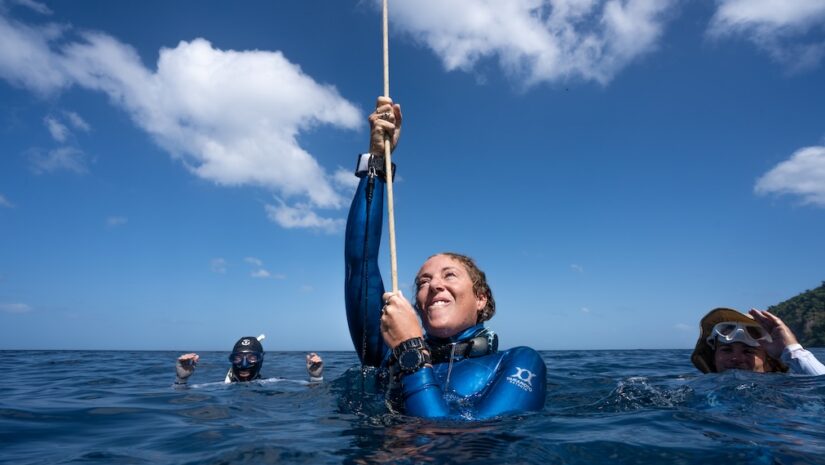
To continue celebrating Women’s Dive Day, we’re shining a spotlight on women making waves in the underwater world… and few embody that spirit more than marine biologist, tour guide, underwater photographer, AND record-holding freediver Cat Cushenan.
From swimming with humpback whales in the Dominican Republic to representing Great Britain at the Freediving World Championships, her career has taken her to some of the world’s most spectacular marine environments. Along the way, she’s combined scientific research, conservation, and adventure while championing ethical wildlife encounters and inspiring others to connect with the ocean.
We caught up with Cat Cushenan to talk about where her passion for marine life began, what it’s really like working alongside some of the ocean’s largest animals, and why freediving has become an essential part of both her career and her life.
Early passions and becoming a Shark Ecologist
Cat’s love for the ocean is about as old as she is! Growing up, she was always playing mermaids and playing underwater fetch in the pool with marbles on holiday. She used to absolutely hate sand, and her dad would have to carry her over into the ocean so she could play. Luckily, she got over that one!
There was never really a moment where Cat didn’t want to be a marine biologist growing up. She remembers sitting in the playroom with her childhood best friend and describing her ‘future uniform’. In her imagination, it was essentially an astronaut suit, like the old-school scuba divers. Sharks were always her biggest passion among all sea creatures, but it wasn’t until studying for her master’s degree that she got the opportunity to delve into that niche properly.
Mindset and safety around ocean giants
When it comes to being in the water with large marine animals, Cat rarely gets nervous. She finds it very easy to relax because she has spent so long learning and understanding body language and the intentions behind specific movements. She has been in positions that would make others nervous, such as a humpback whale calf with a mix of curiosity and no spatial awareness coming a little too close. In those situations, she emphasizes that it is human responsibility to back away, give them space, and never touch them.
Current fieldwork and freediving training
Every year, Cat Cushenan travels to the Silver Bank in the Dominican Republic to work with the humpback whale populations that migrate there to mate and give birth. First and foremost, it’s tourism, but she takes pride in working in one of the most ethical locations in the world to swim with whales. Some of her favorite encounters have been with mothers and their newborn babies among the coral reefs, eighty miles from civilization, working alongside Conscious Breath Adventures.
While she usually travels somewhere afterward to carry out research or underwater photography, Cat has been actively pursuing freediving training. She traveled straight to Dominica in the Caribbean, where she has been training since April. It is her favorite place in the world for freediving, and she has her fingers crossed for a strong performance in her upcoming competitions there.
Upcoming global expeditions and competitions
Straight after her competition in Dominica, Cat will be racing to Tonga to run her own expeditions on a tiny island where only four boats hold permits for whale encounters. Due to the remote location, she also hopes to contribute a significant amount of citizen science through fluke IDs—reminding everyone that you don’t have to be part of a big research expedition to help further the understanding of these gentle giants.
Cat has also been selected to compete for Great Britain in the Freediving World Championships in Cyprus in October, an adventure she admits to being slightly nervous about. After that, she will travel to Norway to spend seven weeks with orcas before heading to Raja Ampat in Indonesia to defrost a little!
Balancing career, national records, and elite training
Finding the time (and financial stability) to train is a challenge; this year, Cat dedicated a full four months strictly to training. Transitioning from an expedition lifestyle to intense training can be tough; while guiding is physically active, deep freediving requires serious fitness. She is constantly looking for sponsors and supporters to enable her to spend more time training.
Cat currently holds the UK national record in the bi-fins discipline, setting a record dive of -80 meters (262 feet) last year. Looking ahead to the Deep Dominica competition, she hopes to sneak a little deeper than that.
Top locations for ethical wildlife encounters
When asked about her favorite places for marine encounters, Cat Cushenan highlights the Silver Bank for humpback whales, the Azores for blue sharks, and Cocos Island for hammerhead sharks. These locations stand out to her because of how ethical and meaningful the interactions are. While clear visibility and incredible animals exist worldwide, a lack of strict regulations can lead to careless interactions. For Cat, being able to relax into an encounter and let the marine life take charge is what makes a location special.
Career advice for aspiring marine scientists
Cat’s main piece of advice for those looking to build a career in marine science is to keep in mind that while you may never be rich, you will always be happy. While returning home can sometimes bring financial worries, being out in the blue reminds her what it’s all for.
On a practical level, she strongly recommends learning to freedive as early as possible. Cat originally picked up freediving out of necessity. To dive deeper and stay underwater longer to tag animals, record photo IDs, and study behavior undisturbed. It has proven to be a vital asset in her career as a scientist.
The golden rule of ethical wildlife interactions
The most crucial takeaway Cat emphasizes is that being respectful leads to a better (and safer) encounter. It breaks her heart to see places where a hundred humans crowd around a whale shark or where people prioritize getting a photograph over the animal’s well-being. She firmly believes ethical encounters are the future of the industry and must be everyone’s top priority.
Final thoughts
Cat shares that she is honored to highlight her work, noting that one of the main reasons she began exploring underwater photography and freediving was to share the magic of the ocean with others and encourage more people to try the sport. She welcomes anyone interested in diving, swimming with whales, or learning about ocean conservation to reach out to her directly.
Connect with Cat Cushenan and follow her journey on Instagram or at www.catsharks.co.uk.