If you are looking to dive in Okinawa, you have found a true divers’ paradise. Located 400 miles south of mainland Japan, the prefecture is made up of 160 islands. It’s scattered across 620 miles between Japan and Taiwan.
That broad territory is full of riches for ocean lovers. Looking for an easy scenic dive? Yup, you can do that. Are you an advanced diver looking for a challenge? Challenge accepted. Traveling with a non-diving family member mainly interested in white sand beaches and postcard-worthy water — yeah, they’ve got that too.
With the abundance of choice, it can be difficult to figure out where to start when planning a trip to dive in Okinawa. Read on for our recommendations.
Where should you visit?
The main island of Okinawa offers dives defined by healthy coral, dramatic limestone, and an abundance of macro life. (Or as one diver put it aptly, “It’s fishy!”)
For those looking for an easy introduction to Okinawa diving and the main island’s marine biodiversity, the Sunabe Seawall in Chatan features an accessible shore entry and a sprawling garden of soft corals. This site is a win for macro photography thanks to a host of colorful nudibranchs and anemone.
And just up the coast is Cape Maeda, home to one of the island’s most famous sites, the Blue Cave, a sapphire-colored cavern, populated by schools of slender sweepers and batfish. Or, go turtle spotting at Kerama Blue, a dive spot with regularly superior visibility. It is a 50-minute ferry ride from Naha. For cave divers, or just topography fans, go for a trip to Miyako Island. It’s a home of underwater caves, arches, tunnels, and swim-throughs, so it is an absolute must.
For adventure seekers, the remains of the USS Emmons are scattered off the coast of Kouri Island. Sitting at 30 to 40 meters, and known for strong currents, this site and its fascinating history will reward advanced divers with incredible views of gun turrets and hull now encrusted with soft corals. Note: most dive shops will require an advanced certification and 30-50 logged dives before visiting.
You’re probably interested in visiting Ishigaki Island because of its year-round population of Reef Mantas. Good choice. Because the waters around the islands are full of cleaning stations (where cleaner wrasse are waiting to pick parasites, dead skin, and bacteria off larger animals), seeing reef mantas is highly likely. Be sure to book your dive early! Prime reef spots like Manta City are limited to five boat dockings at one time. This is done to avoid stressing out the animals. Just avoid December through March, when strong winter winds and heavy surface waves often shut down access to Kabira Bay.
Best time to visit and dive in Okinawa
Okinawa offers almost year-round diving, although it’s worth hesitating on a trip during typhoon season (late July through early October). Otherwise, the islands are an absolute divers’ smorgasbord. October and November offer a shoulder season. At this time, the humidity drops, temperatures remain high, and visibility often surpasses the 100-foot mark. April and May usually have calmer seas, making them a great choice for beginners. But December through March is prime time for fans of hammerheads, humpback whales, and Great Barracuda. Just be prepared for colder waters and rougher seas.
Is Okinawa good for beginners?
In short: yes! With calm seas and a subtropical maritime climate, Okinawa diving is ideal for those looking to secure their first certification or check off new skills. With an abundance of dive shops, competition is high. If you’re venturing into the water for the first time, look for locations that offer smaller class sizes and shore entries.
Accommodation in Okinawa
Stay on the main island of Okinawa at Hotel Collective. The upscale hotel offers larger-than-average hotel rooms, perfect for sorting out gear pre-dive. Naha Port and Tomari Port are both a short ride away. Thanks to the hotel’s location Kokusai-dori (aka “International Street,”) you’ll have plenty of entertainment during surface intervals and no-fly days. On Sundays, the broad boulevard is closed to cars. So, it transforms it into a pedestrian paradise from 12:00 PM to 6:00 PM.
On Ishigaki Island, you won’t surprise anyone at ANA InterContinental Ishigaki Resort with your extra bags. The resort is a go-to for divers! They have larger-than-average rooms, perfect for arranging your gear post dive. They also have a concierge service ready to arrange transfers between dive shops.
Additionally, they win in terms of location. The resort is located just a 10-minute drive from the Ishigaki Port Ferry Terminal, home to the lion’s share of island dive operators. You’ll never miss an early morning boat call. And once you’ve waited for the appropriate time post dive, enjoy their heavy-duty showers and expansive spa amenities. These will help you prepare for the next day’s adventures.
A note on food
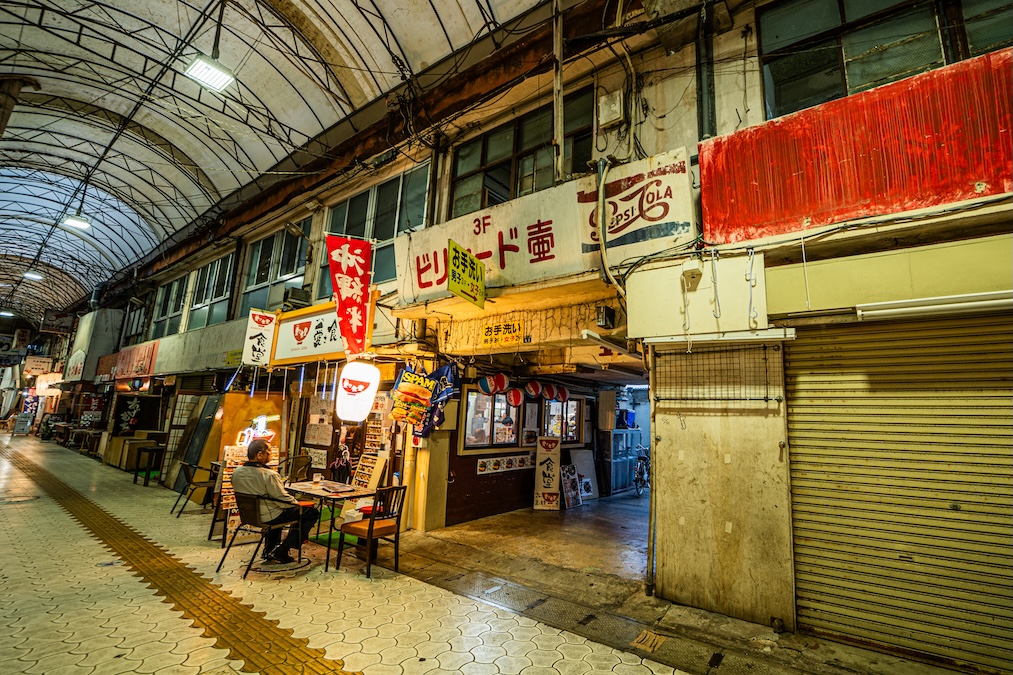
One of the undisputed highlights when you dive in Okinawa is eating. But because Okinawa is geographically isolated from mainland Japan, the local cuisine (Ryukyu Ryori) will be different from what you might expect on the mainland. Dishes are largely made with pork, such as Okinawa soba, chewy, filling wheat noodles (think: a cross between udon and ramen), served in a rich broth. Goya, aka bitter melon, makes an appearance in many dishes. As do sea grapes, AKA tiny seaweed beads that taste like a salty burst of ocean.
If you hit up an Izakaya (a bar known for having a deep bench of shareable snacks), be sure to try Gurukun. It’s a tiny local fish, served deep fried, deeply fermented Shima-Tofu Yo. Also, you must try Okinawa’s pride and joy: Orion Beer. And field research confirms that the Bireley’s Pineapple Soda might be one of the most pleasant ways to hydrate after getting out of the water. Pair it with literally any snack you can get your hands on at the local FamilyMart convenience store.
Because the U.S. military has had a presence on Okinawa for 81 years, there’s also an abundance of culinary cross-pollination. Try Taco Rice, a dish that blends TexMex and Japanese, swapping out the tortilla with a bed of sticky rice. And while A&W has decreased its presence in the United States, the burger chain still operates 24 locations across Okinawa, making it the perfect stop for a post-dive root beer float.
All images by Joshua Mellin.