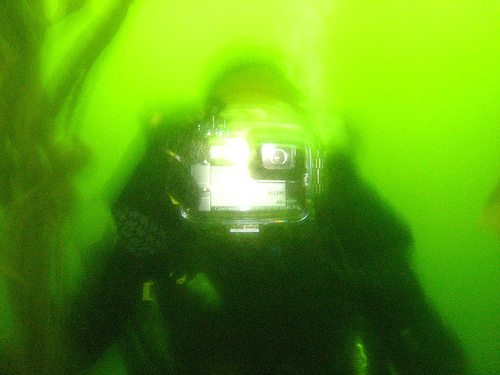
One of the most frequently asked question by divers starting out in underwater photography is what causes distorted and blurry pictures underwater? Most divers will end up taking hundreds of photographs on a dive trip only to find a handful of usable, clear, sharp photographs, with the rest being inexplicably fuzzy and blurry. Here are some useful tips on the causes of out-of-focus pictures underwater which may help point & shoot camera users to get their photographs in sharper focus.
Not enough light
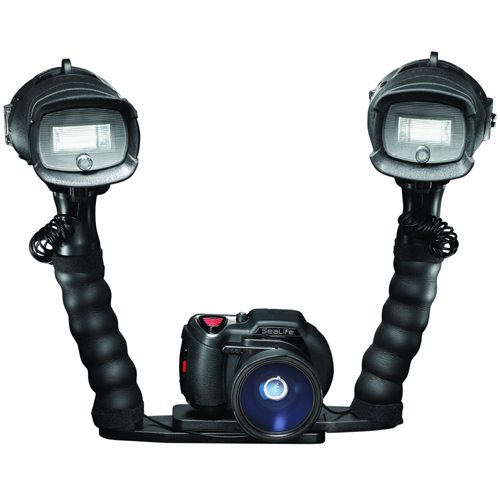
One of the primary reasons for blurry pictures underwater is insufficient light. Poor light makes it difficult for your camera to focus on the subject; it additionally sets your camera to take photos at a slower shutter speed to allow more light to reach the sensor. The slower shutter speed plays havoc underwater when all of your subjects including yourself are moving, and you need to remain stiller than normal. This is the reason why most UW Photographers invest in a good external strobe, or a pair of external strobes to compensate for the loss of light. The inbuilt flashes on most point & shoot cameras are not powerful enough to illuminate subjects at a distance underwater properly, however if you don’t have external strobes, make sure your built in flash is set to forced fire or shoot in shallower waters.
Suspended Water Particles
Often your camera’s autofocus is programmed to lock on to the closest subject it ‘sees’, and will lock on to floating particles or water debris, causing your camera to ‘hunt’ continuously for your subject. Upon inspection of these photographs, if you see the white particles known as backscatter in focus but your intended subject blurry, you are facing a problem with backscatter. Using manual focus to correct this is not possible using a point and shoot, so one has to attempt to shoot subjects on contrasting backgrounds, get up close to your subject, or use an external strobe mounted on the side to illuminate your subject and not the particles.
Shutter Lag
Although most modern point and shoot cameras, have decent shutter lag times, often you’ll get a camera that has a significant delay from the time you depress the shutter till the time the picture is actually taken; this is known a shutter lag. Cameras with shutter lag require the diver to stay still for a moment longer after depressing the shutter release button. This is often hard to do when you are taking a picture of a moving fish, where you need to anticipate the position the fish will be in and press the button; additionally you will need to remain incredibly still otherwise you’ll end up ruining all your photographs. Cameras with long shutter lags are no good for underwater photography, especially since everything is moving.
Camera Preset Mode
Several photographers don’t even realize that their camera’s have separate modes for Macro and Landscape photography. The Macro mode, which usually is indicated by a flower icon on most cameras, adjusts the cameras lens to take pictures with very little distance between the lens and the subject (refer to your camera manual to find out how much distance). If this mode is turned on, the camera may not take good landscapes, or distant pictures, as it is constantly hunting for a Macro subject that is nearest the lens. The same applies for the landscape mode (indicated by a picture of a hill) which if turned on, attempts to focus at infinity or distant objects and not objects nearby. If the landscape mode of your camera is turned on and you are inches away from say a shrimp, you will probably get a blurry picture as your camera which should’ve been in Macro mode is busy trying to focus from infinity.