After spending the past several weeks on the public safety trade show circuit, including attending both the Fire Department Instructors Conference (FDIC) and the Midwest Public Safety Divers’ Conference (MPSDA), one thing is clear: agencies are looking for faster, smarter, and safer ways to operate.
While the two events served very different audiences, the conversations happening on the show floor often overlapped. FDIC focused broadly on fire and rescue professionals, while the MPSDA conference brought together dive teams and underwater recovery specialists from across the region. But whether we were speaking with firefighters, marine units, search-and-rescue teams, or public safety divers, the same themes kept surfacing.
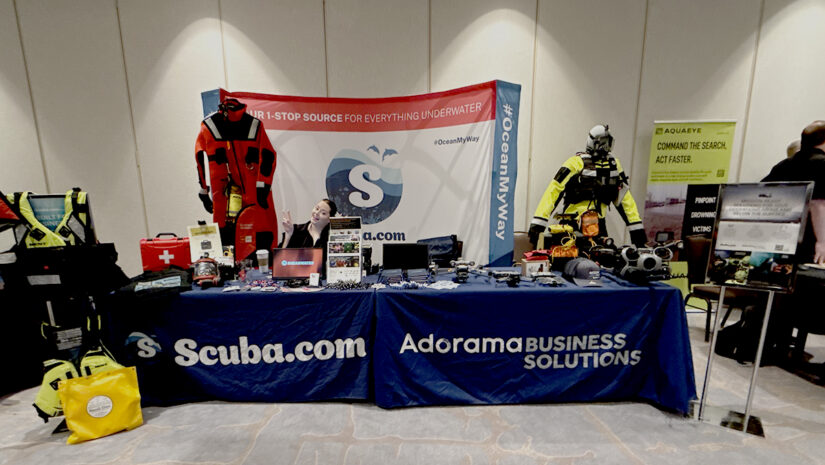
Together with Adorama Business Solutions’ Director of Pro Services, James Bushey, I spent much of both events speaking with agencies about the challenges they’re facing heading into the busy summer season, from procurement bottlenecks to the growing need for technology that reduces risk to rescuers in the field.
Here are some of the biggest trends we saw across public safety agencies right now:
#1: Faster Procurement Is Becoming More Critical
One of the most common frustrations we heard from agencies had very little to do with the gear itself. It was about the purchasing process.
For years, procurement in the scuba and public safety space has often been slow and fragmented. Agencies typically had to call or email for quotes, wait for manufacturers to confirm pricing and availability, and then go back and forth before placing an order. Depending on the item, that process could take weeks.
This demand for a more streamlined and efficient experience is one of the reasons we recently launched Scuba.com Solutions, a dedicated business purchasing portal designed specifically for government agencies, public safety teams, enterprise organizations, and educational institutions.
“In fact, at FDIC and MPSDA, the launch of the new Scuba.com Solutions portal became one of the biggest conversation points at our booth.”
Agencies were especially interested in how our business portal simplifies and accelerates procurement, eliminating many of the delays that have traditionally plagued the public safety purchasing process.
Streamlining the Purchasing Experience
The platform gives agencies access to:
- Customized business pricing
- Tax-exempt purchasing
- Accurate ETAs and inventory visibility
- Purchase order support
- Net 30 payment terms
- Dedicated account management
Instead of waiting several days for pricing or manually processing paperwork, agencies can now access much of that functionality directly online through a free business account.
Agencies can simply register for a free business account, log in, and gain immediate access to dedicated pricing, accurate ETAs, and streamlined online purchasing. Orders can be placed using a government P-card, standard credit card, or purchase order with Net 30 terms, making the process significantly faster and more flexible than traditional procurement methods.
That efficiency is further strengthened through our contract with NPPGov. Teams can handle smaller day-to-day purchases directly through the portal while also using the contract vehicle for larger-scale agency orders. Instead of navigating multiple vendors or lengthy quote processes, agencies can submit a request through the contract and typically receive approved pricing within just a day or two.
The launch also builds on the infrastructure already established by Adorama Business Solutions (ABS), which many agencies are already familiar with on the imaging and technology side. Bringing that same business-focused experience to Scuba.com allows agencies to source critical diving, rescue, and marine equipment much more efficiently.
#2: Technology Is Reducing Risk for Rescue Teams
Another major trend across both conferences was the continued rise of rescue technology designed to minimize human risk during operations.
Public safety divers routinely work in hazardous environments: blackout conditions, contaminated water, swift currents, and confined spaces. Increasingly, agencies are seeking technology that enables them to gather information before sending personnel into dangerous situations.
Remotely operated vehicles (ROVs), sonar systems, underwater drones, and aerial drones generated significant interest at both events.
These tools let agencies search, map, or assess areas without immediately sending a diver, using thermal imaging, sonar technology, and underwater robotics to help teams locate vehicles, evidence, and victims faster while reducing unnecessary exposure for rescuers.
One of the biggest shifts James and I noticed is that agencies are no longer viewing this technology as optional or futuristic. Many now see it as essential operational equipment.
Just a few years ago, underwater robotics systems could cost tens of thousands of dollars, placing them far out of reach for smaller departments. Today, more affordable systems are making that technology accessible to agencies with limited budgets and staffing.
James has spent years supporting public safety operations in the field and has seen that evolution firsthand.
“Agencies are realizing they don’t necessarily need the most expensive solution to make a major impact,” he explained during our conversation after the shows. “Sometimes even an entry-level ROV can help teams avoid putting a diver in the water unnecessarily.”
In one example he shared, a department using compact, lower-cost underwater drones had already completed several successful recoveries without having to deploy already limited personnel into the water.
That accessibility is continuing to change the conversation around public safety technology.
#3: Water Rescue Teams Are Preparing for Summer Operations
As warmer weather approaches, agencies are also preparing for the seasonal increase in water-related incidents.
From beaches and lakes to rivers and recreational boating areas, summer consistently sees an increase in rescue calls involving swimmers, paddleboarders, kayakers, and tourists.
That trend was reflected heavily in purchasing conversations at both events.
Agencies were actively sourcing:
- Swiftwater rescue gear
- Dry suits
- Helmets
- Personal flotation devices
- Rescue rafts
- Surface rescue equipment
- Underwater communication systems
For dive teams, full-face masks and underwater communication systems are critical. Systems from manufacturers like Ocean Technology Systems (OTS) remain widely used for enabling divers to communicate directly with surface teams in hazardous conditions.
Unlike recreational divers, public safety divers often work in environments where visibility is nonexistent, and conditions can change in an instant Maintaining communication with surface personnel is not just helpful; it’s essential.
#4: Education and Support Matter Just as Much as the Gear
One of the biggest takeaways from both conferences was that agencies are not simply looking to buy products; they’re looking for guidance, education, and long-term support.
In fact, many departments are still navigating questions around newer technologies, including:
- What sonar system makes sense for our team?
- What kind of drone do we actually need?
- How do we train personnel on this equipment?
- What solution fits our budget?
Those conversations are becoming just as important as the equipment itself.
In addition to equipment support, Scuba.com now offers ERDI public safety diver training, helping connect agencies with instructors and certification programs that support real-world public safety operations.
At the same time, the collaboration between Scuba.com Solutions and Adorama Business Solutions allows agencies to work across multiple categories from underwater robotics and marine gear to cameras, drones, and imaging systems, while maintaining a single point of contact throughout the purchasing process.
That collaborative approach is especially valuable for larger-scale projects where agencies or marine outfitting companies may need equipment across multiple specialties.
Final Takeaway: Public Safety Needs Are Evolving, and So Is the Industry
Perhaps the biggest takeaway from this year’s trade shows is that public safety agencies are evolving quickly, and suppliers need to keep pace.
Departments are under increasing pressure to operate efficiently, reduce risk, modernize technology, and do more with limited staffing and budgets. At the same time, the technology available to support those missions has advanced dramatically in just the last few years.
That means continuing to listen closely to the agencies we serve and ensuring we build solutions that address the realities they face in the field.
Whether that’s simplifying procurement, expanding rescue technology offerings, or helping teams access training and technical support, the goal remains the same: helping first responders stay prepared, protected, and mission-ready when every second matters.