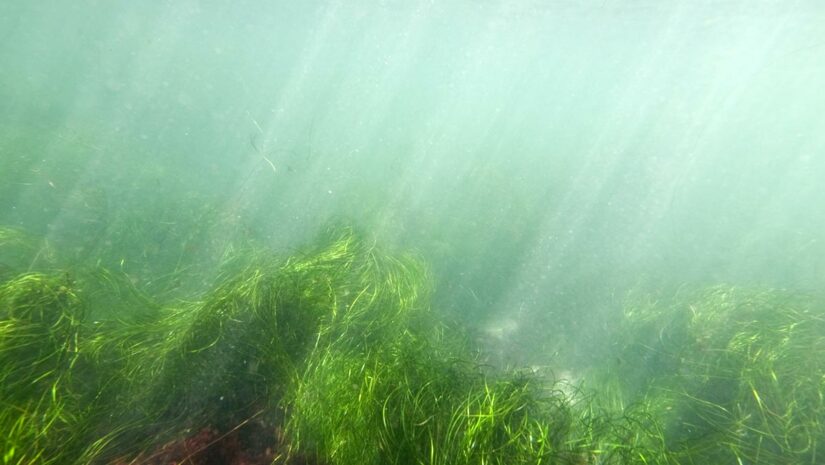
Part 2/2 of our two part series on Tips for diving in kelp forests. If you haven’t read the first part click here.
Swim single file
While diving in kelp, it is always easier to have your buddy or group swim single file. This causes the least disruption to the environment allowing the lead diver to navigate and clear the path through the kelp, and also ensure that if the lead gets tangled, there is someone behind you to help extricate you.
Glide don’t Swim
The smoother and fewer your movements, the easier it is to dive through kelp. Minimal fin strokes coupled with controlled buoyancy will allow a diver to sail through kelp without getting tangled.
If tangled don’t Panic!
If you should get tangled in kelp, the important thing is to remain calm. Thrashing about will only get you more tangled. Try figuring out what part of you is tangled, usually the first stage gets caught, so reach backward carefully and try to free yourself. Backing out of the kelp carefully might also help get free. Signal your buddy if he/she can better spot the cause of entanglement.
Do not Ascend if you get tangled
Should you get tangled in kelp, never inflate your BCD or try and ascend until you get free. Ascending will drag more kelp onto the diver making it more difficult to get free.
Carry a Dive Knife
If you cannot extricate yourself from the kelp, relax, it’s only a plant. Diver safety comes before the marine ecology, so try gently breaking the kelp, or better yet use your dive knife to cut free. As long as you don’t uproot the entire plant from its base, the kelp should grow back.
Take off your BCD as last resort
If you simply cannot free yourself, carefully undo your BCD and try to free the offending kelp.
Ascend by looking for sand flats away from the rocky surface down slope
Remember that a kelp forest is very similar to diving in an overhead environment, as kelp forms a canopy at the surface that is difficult to break through. One way of ensuring you are not swimming up into a canopy is to look for a sandy patch of the sea bed further down slope. Kelp attaches to the rocky bottom of the sea bed.
Swim below the kelp canopy under the surface.
While ascending if you come across a canopy at the surface, it is always better to swim under the canopy and navigate your way to a clearing or to your dive boat as a surface swim is extremely difficult over a canopy of kelp.
Carry a Pony tank or a Reserve
As with overhead environments, swimming under the canopy to find a clearing uses up a lot of your air. Getting tangled in and trying to free yourself from kelp can also consume a lot of your air supply. Its always a good practice to carry with you a pony tank that will give you that extra time needed, incase you get tangled or lost under the canopy.
Kelp Crawling
Should you have ignored all the good advice and still managed to surface in a kelp canopy, you may need to perform what is known as the Kelp Crawl to surface swim your way back to your dive boat. Inflate your Buoyancy compensator fully, using your arms to clear your way to the surface. Extend your arms over the kelp in front of you and push downward while performing a butterfly kick to push you over the kelp and make your way slowly to your boat. Be advised, the kelp crawl is rather exhausting, and is effective only over shorter distances.