In our previous article about cave diving, you learned how caves and their entrances are formed. Keep reading to learn about two unique features commonly found in caves, speleothems, and haloclines.
For a cave diver to explain what makes cave diving so amazing, they have an uphill battle. Many divers consider cave death traps or claustrophobia inducers. So, when the cave diver explains that there’s rarely any life there, the non-cave diver considers that person even loony.
Yet most cave divers will explain that they love the formations, the sense of flying, and the mind-distorting part of the dive, where fresh and saltwater mix. To understand cave diving, you must realize speleothems and haloclines.
Speleothems
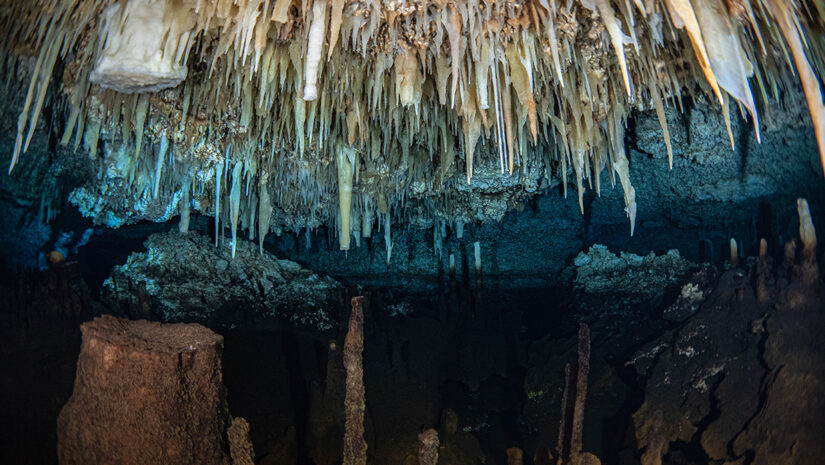
A speleothem is a formation in a cave caused by minerals being deposited by water. You may more commonly know them as stalactites and stalagmites.
When cave diving, speleothems are part of the drive to explore a submerged cave. Their beauty, size, and shape are something you won’t see on a reef dive.
Unfortunately, caves close to a city, caves discovered longer ago, and caves that are easily accessible tend to have the most damage to speleothems and are exceptionally shallow in the cave. This is due to higher traffic from more, typically new divers. Unfortunately, Less experienced divers don’t always have ideal buoyancy control and can run into speleothems, breaking off large pieces.
Submerged speleothems were formed long ago during an ice age when water levels were significantly lower, and the caves were dry. As water seeped through the limestone, it carried minerals through the material. As each drop fell from the roof, a small deposit of minerals was left. Where the drop landed, another small deposit was gone.
Over time, these small deposits add up to large stalactites, stalagmites, and columns. The ice age ended, the caves flooded, and you can see speleothems on your dive.
A fun way to remember the difference between stalactites and stalagmites is that stalactites hold tight to the roof so they don’t fall, while stalagmite uses their mighty strength to hold the roof up.
Haloclines
Most divers are familiar with the depth in water where water takes a decrease in temperature, known as a thermocline, but when cave diving, you’re also likely to experience a halocline.
A halocline is where the less dense freshwater floats on top of the more dense salt water. Due to their different densities, they do not perfectly mix and cause a strange visual aberration. Also, due to the difference in densities, the color of the water appears different on both sides. Buoyancy also changes, so while undergoing cave diving training, you’ll learn how to prepare and adjust for this change.
Depending on how pronounced the halocline is, visibility between layers may be zero. In places like Mexico, where the ocean water is warmer than the freshwater flowing through the ground, a cave diver will feel a reverse thermocline where the water gets warmer as they go deeper through the halocline.
In the next part of our Cave Diving series, we’ll discuss the difference between a sinkhole, cenote, cavern, and cave!
Have you been diving through a halocline?