A question that gets asked a lot by beginner and intermediate divers alike is, what is the best way to enter the water from a dive boat or platform? The truth is, that there is no one good method, and the method one should choose is usually determined by a combination of the type of platform you are diving from, the what you’re most comfortable using, and the safest way determined by the conditions.
There are four basic types of water entry procedure for Scuba Divers that we will cover today: wading/shore entry, giant stride method, seated entry and back roll entry.
Wading Entry Method
The wading entry procedure is performed from a beach or the shore. It involves wading out to your dive site by walking backwards while shuffling your feet to avoid stepping on sharp rocks and to scare away bottom dwelling creatures like rays. While it may sound like an easy method of entry, wading through the surf backward while wearing heavy scuba diving equipment is no easy feat. Divers should wade with their BCD’s partially inflated and regular in their mouths and wade till the water gets around waist high after which one can swim. Avoid using the shore wading entry when conditions are rough, and surface is muddy, or you could end up losing a fin.
The Giant-Stride Entry Method
One of the more common methods of entering the water, and also one of the easiest methods is the giant-stride entry. Most commonly used while diving off a dive boat, but can also be used to step off a pier or jetty where the water is deep enough. The giant stride entry method can be used while diving into deep water or where the platform is steady. This method involves getting your scuba gear on in the boat itself, and standing on the edge of the dive platform will the ball of your fins on the edge. Then holding your mask and regulator with the heel of your palm on the regulator and fingers holding your mask in place, step off the platform with a giant stride forward. Once in the water bring your legs together to return to the surface, recheck your gear and signal the boat that you’re OK and your buddy to begin decent. The giant-stride method of entry is best used where all divers assemble at the surface of the water before descending together all at once. When currents are strong or surface conditions poor, this entry method should not be used.
Seated Entry Method
The controlled seated entry method is best used where the water is too shallow for a giant stride off the boat or where your boat/platform is low to the surface of the water or the platform is unsteady. Seated entry involves kitting up in the dive boat itself and while seated at the edge of the boat/platform, using your hands on each side of you, lifting yourself up and outward with your hands and lowering yourself into the water. This method of entry is great when you are diving near shallow reefs, where jumping in could cause the diver injury. Care should be taken while pushing yourself off the boat that your clear both yourself and your tanks from hitting the side of the dive boat.
Back Roll Method
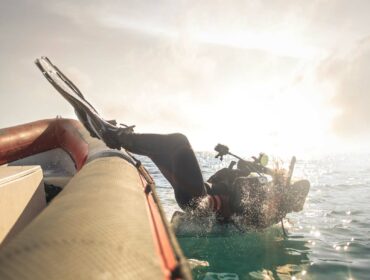
The back roll or rear roll is the preferred method for entering the water from a small boat as fully kitted divers standing up in a small craft could easily upset the balance of the boat. To execute the back roll, the divers should be fully outfitted and seated at the edge of the gunwale of the boat facing inwards with his tank facing the water. Then with the chin tucked in and one hand holding the mask and regulator in place, the diver rolls backward moving through a full somersault into the water. While this method looks difficult, it is quite easy to perform and great for immediate descents with a group of divers off a small craft.
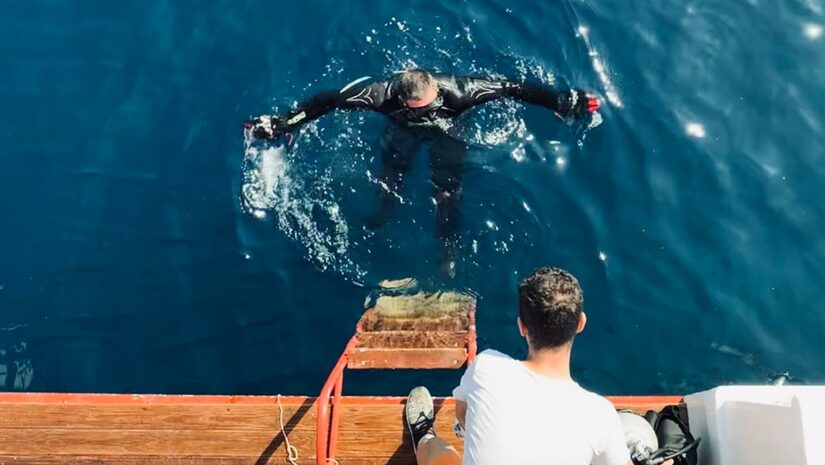
Apart from the four basic water entry methods shown above, there are several other such as feet first step off, while diving off high platforms, or donning the BCD once in the water, ladder entry etc. which are essentially variations of the basic entry methods. Once again the method you chose should always consider safety first, and the situation/platform you diving from. Over time water entry method selection becomes almost automatic to a diver.