What is Ice Diving?
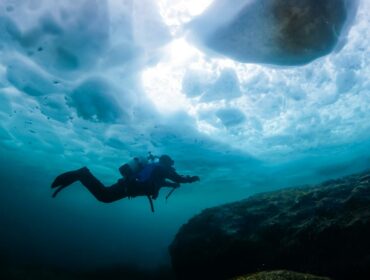
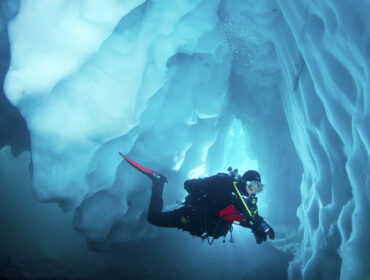
Ice Diving is a form of penetration diving similar to wreck or cavern diving, where the dive takes place under ice. As the diver is under the ice for the dive, this is considered an overhead environment with usually a single entry/exit point on the surface and is considered an advanced type of recreational diving requiring special training and equipment. Most ice diving takes place in frozen lakes where the diver is required to wear special exposure suits or dry suits, in order to stay warm during the dive. Divers penetrate under ice through sawed rectangular holes and go down in buddy teams. A safety rope is tied to the waist of each diver, and the divers hold the rope. A person called the ‘tender’ on the surface holds the rope as a safety measure.
Why do a specialty course in Ice Diving?
The enchantment of Ice Diving lies in the unique aquascapes formed underwater by the ice. The air bubbles exhaled by divers seem to have a life of their own, getting trapped under the ice overhead and rolling around like silver blobs of mercury. The atmosphere under the ice is somewhat eerie yet calming and humbling. Learning to Ice Dive also gives you the opportunity to dive throughout the year, and explore some of the same water bodies you dived in during the summer . The thrill of ice diving is similar to that of cavern diving in an overhead environment except that it is much more challenging. Ice Diving is also considered one of the most extreme adventure specialties recreational diving offers. It combines the need for good technical skills with the use of specialized scuba diving equipment often creating the debate whether Ice Diving should be considered technical diving.
What does the Course cover?
The Ice Diver course includes three open water training dives, which are conducted over at least 2 days. Penetration training dives are limited to within the light zone and within 40 metres/130 feet from
the surface, vertical and horizontal distance included. No out-of-air drills are practiced in the overhead environment. Dives are typically done as a group working with support personnel, divers, tenders, and safety divers. Divers are required to learn to control buoyancy, navigate under the ice, and keep in contact with the lead diver and tenders via line pulls.
The course covers the following:
- Reasons and opportunities for ice diving,
- Scuba Equipment considerations
- planning, organization, procedures, techniques, problems and hazards of ice diving.
- site selection, preparation and hole-cutting procedures
- special dive equipment, safety lines, signals, communications, line tending and line-securing techniques
- effects of cold, emergency procedures and safety-diver procedures
There is no written exam to successfully complete the PADI Ice Diver specialty course however the diver must successfully complete the knowledge sessions on all the key information areas and perform the three training Ice dives to the satisfaction of the instructor.
Prerequisites to do the Course
To qualify for the Altitude Diver course, an individual must:
- Be certified as a PADI Open Water Diver, PADI Junior Open Water Diver or have a qualifying certification from another training organization.
- Be 18 years of age or older.