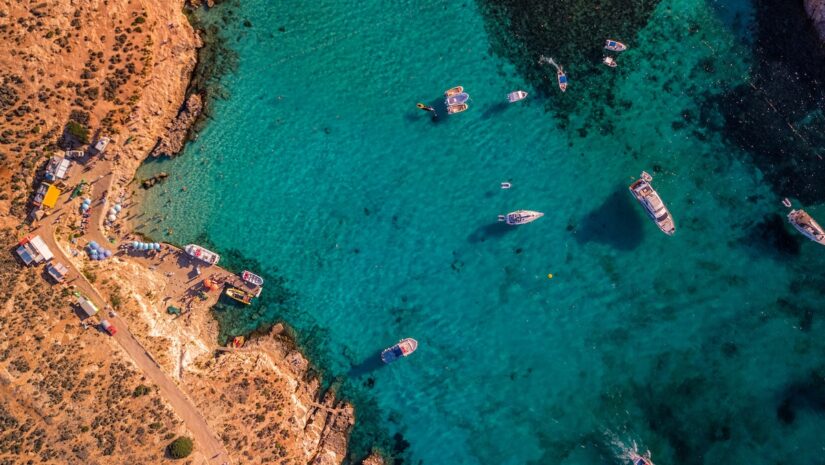
Located in the clear waters of the central Mediterranean, the Maltese archipelago is a top-tier destination for scuba divers of all levels. To give you a closer look at what makes this location so special, we created the Dive Malta video series.
Exploring the Sea Caves of Gozo
While the main island of Malta is famous for its shipwrecks, the smaller island of Gozo is celebrated for its stunning natural underwater geography. The limestone cliffs that tower over the sea continue underwater, creating a playground of caves, tunnels, and arches. Cavern diving in Gozo is unique because it allows divers to explore overhead environments without needing full cave diving certification, as long as they stay within the “light zone” where natural light is still visible.
Popular Dive Sites in Gozo
One of the most famous sites is the Blue Hole, which begins in a natural rock pool that leads divers through an underwater archway and out into the open ocean. Another major attraction is the Inland Sea, featuring a long, narrow tunnel that connects a small inland lagoon to the open sea. As you swim through the tunnel, the light fades to a deep blue, creating a cathedral-like atmosphere before you emerge onto a sheer wall that drops deep into the abyss.
There is also Cathedral Cave, known as the Blue Dome, where divers can surface inside a massive air-filled pocket under the cliffs to see the water glowing electric blue from the sunlight below.
Technical Diving in Malta
Malta is often called the “technical diving capital of the Mediterranean.” Technical diving, or “tech” diving goes beyond recreational limits. The activity allows divers to go deeper and stay underwater longer using specialized equipment and gas mixtures. The geology of the Maltese islands makes them perfect for this because the underwater walls drop quickly to depths of 50 to 100 meters. This means divers do not have to take a long boat ride to reach deep water.
Tech divers here can visit historical wrecks that are too deep for normal scuba diving. Famous sites include the HMS Stubborn, a British submarine from World War II resting at 57 meters (187 feet), and the Polynesian, a massive French ocean liner torpedoed in WWI that sits at over 60 meters (197 feet). Because the deep sites are accessible from shore or short boat rides, divers from all over the world come to Malta to take technical diving courses. They learn how to use twin tanks, rebreathers, and decompression gases in clear and calm waters.
Malta’s History Through Photography
Underwater photographers love Malta for two main reasons: the incredible water clarity and the dramatic shipwrecks. The lack of strong currents and tides means the water remains clear. This allows photographers to capture wide-angle shots of massive ships without floating particles ruining the photo.
Famous Historic Sites in Malta
One popular subject is the P29 Patrol Boat, a former German minesweeper sunk in 2007 off Cirkewwa. It sits upright at 34 meters and is famous for the machine gun still mounted on its deck. Photographers often frame divers behind the gun for a dramatic action shot.
Another favorite is the Rozi, a tugboat sunk in 1992, which is usually surrounded by clouds of fish. It is perfect for photographers who want to capture the contrast between the rigid steel of a man-made ship and the soft and colorful life of the reef.
Because many of these wrecks are deep, colors fade quickly. So, photographers use powerful strobe lights to bring back the reds and oranges of the sponges growing on the steel hulls.
The Artificial Reefs and Wrecks
Wreck diving is the primary attraction for most visitors to the islands. The government has a strategy of “scuttling,” or intentionally sinking, old ships to create artificial reefs. This encourages marine life to grow and gives divers exciting new places to explore.
The MV Karwela
The MV Karwela is one of the most famous of these artificial reefs. It is a 50-meter (162 ft) passenger ferry that was scuttled in August 2006 off the coast of Gozo. It was stripped of dangerous materials and sunk to a depth of 35-40 meters. The wreck stands perfectly upright, and a highlight for divers is the central staircase. Because the ship was stripped of doors and glass, the staircase is safe and easy to penetrate, making for an eerie but beautiful swim-through.
Located near the Karwela is the MV Comino Land, which rests slightly shallower at 32 meters. Unlike the Karwela, the Comino Land had its paint removed before sinking to encourage marine growth, and it sustained some damage to its bow. This gives it a grittier, more “aged” look compared to its neighbor. Another massive attraction is the Um El Faroud, an oil tanker that sits in 36 meters of water off the south coast. The ship broke in half during a storm, allowing divers to swim easily into the massive cargo holds.
One of the strangest attractions on the MV Karwela is a Volkswagen Beetle parked on the stern deck. This wasn’t part of the original ship. After the ferry was scuttled, local divers engaged in a fun but difficult project. They floated the car out on barrels and carefully released the air to sink it directly onto the deck. It now rests there as a quirky photo opportunity for divers visiting the wreck.
Benefits of Sidemount Diving
Sidemount diving is a style of diving where the tanks are clipped to the diver’s sides rather than mounted on their back. Originally developed for squeezing through tight caves, it has become very popular in Malta for wreck diving.
Many of Malta’s wrecks, like the Karwela and the Um El Faroud, have narrow engine rooms and corridors. With tanks on their sides, divers have a lower profile and can slip through smaller openings without banging their equipment against the wreck.
Sidemount divers also carry two independent tanks, which provides a huge safety benefit when exploring deep wrecks or caverns in Gozo. If one tank has a problem, the diver has a completely separate backup supply immediately available. Additionally, because you can clip the tanks on in the water, sidemount is great for Malta’s rocky shore entries. This saves divers from walking over rough limestone carrying a heavy twin-tank set on their backs.
Book your trip to Malta
If you are planning to visit Malta, you are in for a treat. Whether you are a beginner looking to swim through the sunlit arches of the Blue Hole, or an experienced technical diver wanting to explore the deep history of World War II submarines, these islands offer world-class diving. It is surely a destination that should be on every diver’s bucket list.