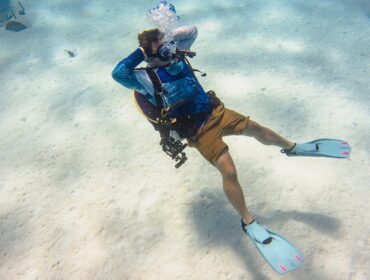
For many divers, currents are a reality on every dive, but for those who don’t have regular experience a current can be mildly intimidating. With a few tips in mind, diving currents can be easy and enjoyable. For both shore and boat based current dives, it’s incredibly important to keep your body and gear streamlined. Staying horizontal in the water and keeping gear from dangling helps. Currents closer to the bottom also tend to be less noticeable than those at the top, so if your air supply and dive profile allow, stay low to work through a current.
Shore Diving a Current
If your favorite shore dive location is known for strong currents, keep in mind that those currents are due to tidal exchange. Tidal exchange is the volume of water that moves in and out of the shore area due to the differences between high and low tide. To successfully plan a shore dive in a current, it’s best to pick up a tide schedule, or find one of the many online tools available. The numbers you’ll want to look for are high tide time, low tide time, and exchange (measured in feet or meters).
In many areas, high tide tends to be a better time to dive because the influx of additional salt water is usually less turbid than the outgoing water associated with a low tide. However, if high tide occurs at inconvenient times, low tide will work fine — but be aware that visibility may be reduced.
When looking at the exchange, note that the larger the number, the stronger the current. In some parts of the world, the tidal exchange may only be a few feet, so currents will be minimal. In others, normal tidal exchanges can be 20 or more feet, meaning stronger currents. The strength of the current will determine your perfect dive window. If the exchange is incredibly large, your dive window may only be through 20 minutes before to 20 minutes after the high or low tide time.
If you’re new to an area, we recommend finding local divers to get pointers on a specific dive site so you don’t get swept away.
Boat Diving a Current
Depending on your dive boat, you may have live boat pickup. Live boat pickup means you go on your dive, and when you surface, you signal the boat and they come get you. If this is your situation, consider yourself lucky and enjoy the dive!
For those times when live boat pickup isn’t available, good navigation and some simple tips will take the problems associated with diving a current out of the equation. As a general rule of thumb, start the dive into the current. After you’ve reached your halfway point, determined by tank pressure or dive time, simply turn around and ride the current back to the boat. Since riding a current will be easier, faster, and require less air, you should have an ample reserve of air should you decide to stop for one more picture.
Diving in currents can be an incredible experience due to the amount of nutrients, and therefore marine life, that comes along with the currents. With these basic tips, you should be able to navigate safely through even the most extreme currents.