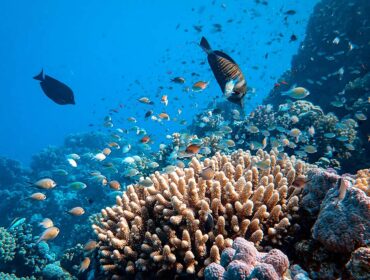
Abu Dhabi is the capital city as well as the largest of the seven emirates that make up the United Arab Emirates or the UAE. Located on the Gulf of Oman and the Persian Gulf, between Oman and Saudi Arabia; the Coral reefs of Abu Dhabi live in some of the most stressful climatic conditions with extreme seasonal temperature variations as well as very high salinity. In Abu Dhabi the coral reefs are formed by three major species; Staghorn Coral which comprises of roughly 70% of coral and Brain Coral and Star Coral making up the reminder 30%. While the waters of Abu Dhabi, may not be a Scuba Diving paradise, a lot of local marine life and fisheries depend on the coral reefs.
The Environment Agency, Abu-Dhabi (EAD) earlier this year, launched a Coral Reef Restoration Program in coordination with Tokyo University of Marine Science and Technology (TUMSAT) and Japan Oil Development Company, Ltd. (JODCO).
This pilot program will study the feasibility of coral restoration in Abu Dhabi evaluating the state of corals and the applicability of the technology in the form of use of coral settlement devices to Abu Dhabi reefs. If successful, the program will provide opportunities for coral reef restoration not just in the UAE but other parts of the world as well.
The research team and divers have been installing Coral Settlement Devices close to the Saadiyat Island and Al Dabeiyah located in the Persian Gulf just off the mainland. The coral settlement devices were developed by Dr. Mineo Okamoto of TUMSAT (Tokyo University of Marine Science and Technology), and have proven successful in rehabilitating coral reefs in various parts of Japan especially in Sekisei Lagoon, the largest coral reef in Okinawa. The devices resemble stacked trays of discs of calcium carbonate and other materials. The coral larvas settle on any hard substrate, in this case the discs which are cracked and perforated to allow coral polyps to settle and then grow layer by layer building colonies over it. The devices can be moved from designated coral ‘nurseries’ to final reef sites helping strategically place the coral in areas where they are needed the most.
A second device known as marine blocks, which resemble bricks with several holes in them were also installed around Abu Dhabi’s reefs from March to May during the expected coral spawning season , with the intention that the coral spawn find the substrate provided suitable enough to settle in and grow.
The EAD estimates that the coral in these devices will grow at 1cm (10 mm) per year that is if they grow at all. However the project has been deemed as a necessary step ever since the WWF- World Wildlife Fund listed the region of the Arabian Gulf among the 43 marine eco-regions classified as “critically endangered.” So far the project has shown positive signs of becoming a success, however it remains to be seen how many of these coral settlement devices will the region require to make any significant impact to the ever depleting coral gardens of the Gulf.