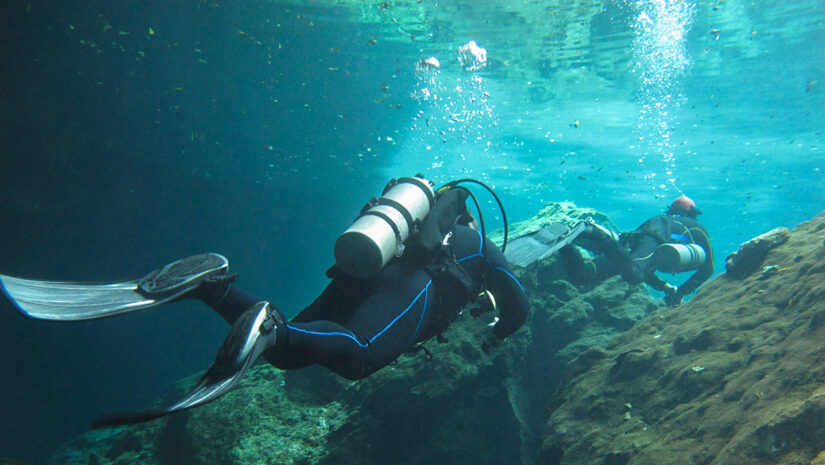
While scuba diving is a fun activity and is open to people of a wide range of ages and agility levels, it does have its dangers. You are, after all, entering into an alien environment, one in which you have to bring your life support system along to visit. Inexperienced or foolhardy divers who try to exceed the limits of their training sometimes don’t live to tell the tale. Cave and cavern diving are particularly susceptible to accidents, and cave diving safety should be frequently discussed.
First and foremost, never enter into a cave if you are not certified to do so. Cave diving is considered one of the most dangerous and challenging fields of scuba diving. While it may be tempting to take a quick look around, you have no idea what waits beyond the mouth of the cave. You could find yourself in a tight spot, unable to turn around or back out. You could even swim a short way into a cave, turn around to leave, and face multiple tunnels with no way to indicate which one is the exit.
Cave diving safety protocols
Follow what is known as the ‘Rule of Threes.’ Cave divers use not one or two light sources but three. They will also use at least two tanks, either connected using a manifold mounted on their backs or independently under each arm in a side-mount configuration. They divide their gas into three parts: one-third to get in, one-third to get out, and one-third as an emergency reserve. Many experienced dive teams will choose an even more conservative gas management plan due to the potential for plan-altering incidents.
They also use lines, either guidelines laid by previous cave explorers or by laying a new line themselves. Dive arrows (triangular) and cookies (round) are plastic markers placed on the lines to denote which direction is the way out. Each diver customizes these markers so they can be identified by touch in case of a silt-out. If a diver becomes confused, lost, or loses visibility in a silt out, these lines and arrows can save their life.
Divers should never leave the guidelines to explore an anteroom or chamber without laying a connecting line. By using detailed maps, divers can take the correct number of reels for their dives and know roughly when each will be needed.
Conclusion
These are just a few fundamental reasons cave-certified divers should never hesitate. However, it is tempting to explore these hidden underwater worlds. Contact your local dive center to learn more about cave diving safety and to get properly certified. A fantastic underground world awaits those with the skills to explore it!