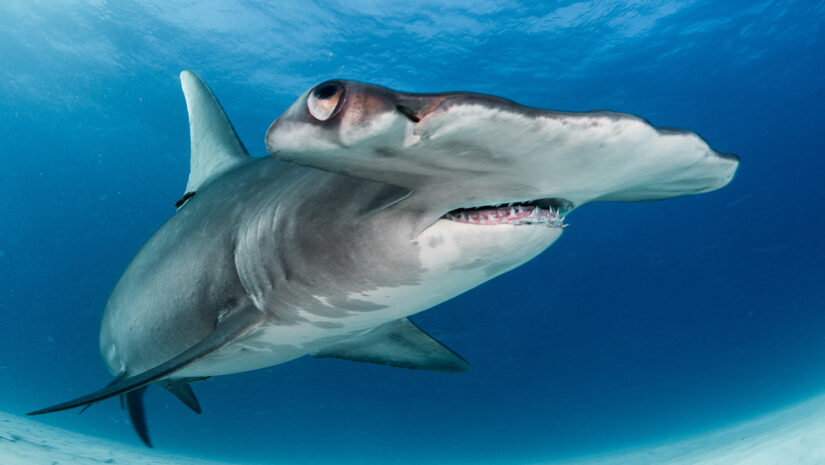
Oh, the shark. Most people are terrified of them, yet have never seen them but in pictures. They are mutilated for their fins, the eating of which is a symbol of affluence, yet little respect is paid to the shark’s amazing legacy. Sadly, the decimation of many species has been so extreme that the shark may one day join the ranks of many extinct creatures whom we can only imagine today. It’s time some of the sharks’ finer points were brought to light, so we are here to cover three cool shark facts.
Sharks have been here quite a while
Scientific evidence from the study of fossils indicates that sharks have been inhabiting Earth’s oceans for a period of 400 million years. Fossil evidence shows dinosaurs only started showing up about 230 million years ago, making the shark one of the planet’s oldest inhabitants. Although sharks have evolved from their early inception, for the last 100 million years or so, they have remained largely unchanged. Many species have become extinct within this time, but the shark, on the whole, has survived through millennia as a testament to their adaptive capabilities and tenacity. Are humans to be responsible for the ultimate demise of their species?
Sharks are knowledgeable
Many people think the shark is an instinct-driven predator whose only motivation is blood. However, research has shown that sharks are indeed intelligent animals, displaying cognitive behaviors related to problem-solving, social activity, and curiosity. They have been observed working as team members to fulfill a task. Some scientists think the intelligence level is comparable to that of a canine. There are many anecdotal reports that the great white can display nipping and nose bumping to figure out what a diver or a vessel is, but when their curiosity is satisfied that it is not a food source or threat, it swims away. Sharks are sensitive to electromagnetic currents, and will steer clear of bait, humans, or areas that exhibit such properties, regardless of whether it is a regular feeding ground or source of food.
Sharks are vital to the world’s ecosystems
People are often misinformed about the danger a shark presents to human life. While attacks have happened, it is statistically more likely for a person to get hit by a car or fatally stung by a bee than it is to be attacked by a shark.
Humans are not a tasty dish to the shark; they prefer the blubber of sea lions and other ocean creatures. The danger that is less reported is what will happen to the planet’s ecosystems if sharks are removed from the food chain. For example, sharks play a vital role in keeping the number of herbivorous fish at bay. If herbivorous populations were allowed to increase ad infinitum, the phytoplankton that is the source of half of the world’s oxygen would face overconsumption by herbivorous creatures. Sharks resemble lions and tigers in the food chain; their place at the top allows for a filtering effect that affects every living thing. Because there is no precedent set for the consequences of their extinction, many turn a blind eye to theories regarding this very real situation.
This information is given with the intent to make people think beyond the present time, if only for a minute. Every creature has a role on this planet, and the shark is one of the most important. Instead of acting out of fear or ignorance, we should strive to become educated on the whole issue and make choices based on that information.
As it’s been said in various ways over history, knowledge is power.